


Living with missing teeth changes more than your smile; it alters how you eat, speak, and interact with people every day. Modern implant dentistry restores not just appearance but chewing function and facial support, giving many patients a renewed sense of confidence. Whether a single tooth is lost or an entire arch needs attention, implant solutions are designed to feel and perform like natural teeth.
Implants are engineered to provide a stable foundation for restorations, which means fewer compromises when it comes to food choices and everyday activities. Because implants integrate with the jaw, they help preserve bone and support the surrounding facial structure, reducing the sunken look that sometimes follows tooth loss. For many patients, that combined functional and aesthetic benefit is the primary reason to pursue implant therapy.
Our approach focuses on clear, patient-centered planning: we evaluate oral health, review imaging, and discuss realistic outcomes so you understand how implants can fit into your life. If you’re weighing options for tooth replacement, exploring how implants can restore long-term function is a strong first step toward a stable, comfortable smile.

Unlike removable prosthetics, implants act as artificial tooth roots that are anchored directly into the jaw. This connection gives them extraordinary stability and allows attached crowns, bridges, or dentures to behave more like natural teeth when biting and speaking. The result is a secure restoration that rarely feels foreign or unstable during normal activities.
Because they replace the root as well as the visible portion of the tooth, implants deliver mechanical support that helps maintain adjacent bone levels. That biological advantage keeps neighboring teeth from drifting into empty spaces and helps preserve the natural contours of your jawline and smile.
Patients often describe implants as the most "natural-feeling" replacement option available. That sense of normalcy comes from predictable engineering, careful placement, and restorations shaped to match your unique bite and appearance.
A dental implant is a small, biocompatible post—typically titanium or a titanium alloy—designed to integrate with the surrounding bone. Once the post is placed, the body gradually grows bone around the implant in a process called osseointegration. This fusion creates a durable anchor capable of supporting single crowns, multi-tooth bridges, or implant-retained dentures for many years when maintained properly.
Beyond the post itself, successful implant therapy relies on thoughtful restorative design: the shape and material of the crown or denture, occlusion (how teeth come together), and the health of the surrounding gums all influence long-term performance. Each case is customized so the final restoration balances function, durability, and natural appearance.
Modern digital tools—such as 3D imaging and computer-guided planning—help clinicians place implants with a high degree of precision. That accuracy minimizes surprises, shortens chair time, and contributes to predictable outcomes for patients seeking reliable tooth replacement.
People choose implants because they offer advantages that affect daily life: reliable chewing, clearer speech, and a restoration that typically does not require removal for cleaning. Compared with traditional removable dentures and some bridge designs, implants reduce the risk of awkward movement or slippage during speaking and eating.
Implants also deliver biological benefits. By providing stimulus to the surrounding bone, they slow or prevent the resorption that occurs when teeth are missing, helping maintain natural facial proportions. That preservation of bone and soft tissue often contributes to more pleasing long-term aesthetic results.
Another practical benefit is longevity. With correct placement, excellent oral hygiene, and routine professional care, implant-supported restorations can last many years. While they are not entirely maintenance-free, their predictable performance makes them a durable choice for long-term smile rehabilitation.
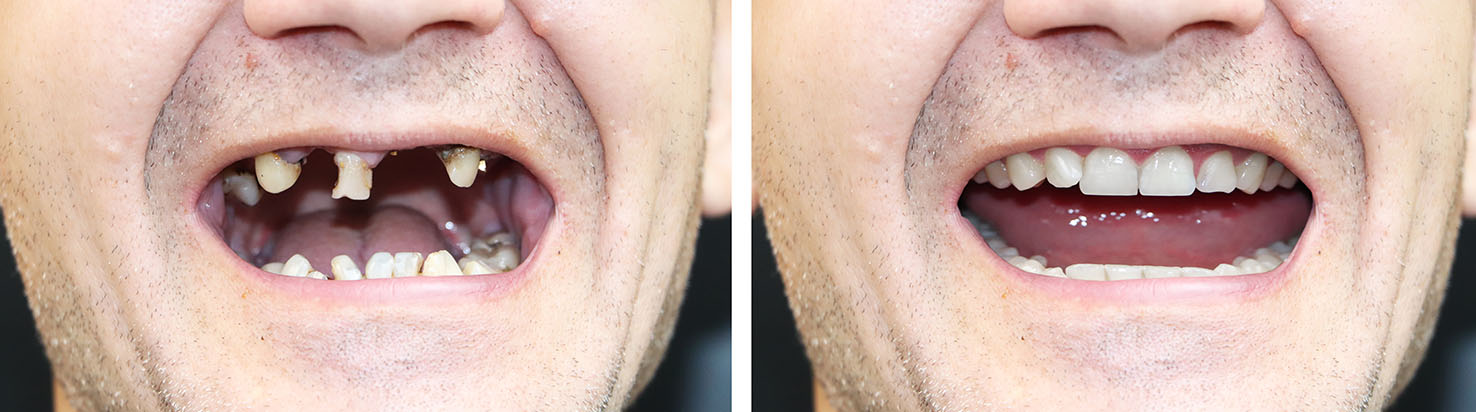
Implant dentistry offers a range of restorative strategies depending on how many teeth are missing, the condition of the supporting jawbone, and the patient’s goals. From single crowns that replace one tooth to full-arch solutions that restore an entire mouth, implants can be adapted to meet both conservative and comprehensive treatment needs.
Choosing the right restorative design takes clinical judgment and input from the patient. Some solutions prioritize a fixed, non-removable result; others balance stability with the convenience of a removable overdenture. Each approach has trade-offs, and we guide patients toward the option that best aligns with their lifestyle and oral health.
Advances in materials and prosthetic design make it easier than ever to achieve a natural appearance while maintaining function. Implant-supported restorations can be crafted from high-strength ceramics, porcelain-fused materials, or hybrid acrylics depending on strength, aesthetics, and patient preference.
Determining candidacy for implants involves a careful review of medical history, oral health, and lifestyle factors. Sufficient bone volume and healthy gum tissue are important, but a history of controlled systemic conditions or past dental work does not automatically rule someone out. We evaluate each case individually to develop a personalized recommendation.
Imaging—often including digital x-rays and 3D scans—helps the clinical team assess bone quantity and quality, locate vital anatomic structures, and plan precise implant positions. Treatment planning is a collaborative process: we discuss expected timelines, the number of appointments, and the sequence of surgical steps so patients know what to expect.
At the office of Crowns Now Family Dentistry, our goal is to present realistic options and answer questions clearly so you can make an informed decision about implant therapy. We tailor recommendations around long-term oral health and your personal goals for smile function and appearance.
Implant therapy typically follows a staged process: initial consultation and planning, surgical placement of the implant posts, a healing period during which osseointegration occurs, and finally restoration with crowns, bridges, or dentures. Some modern protocols allow for immediate provisional restorations in carefully selected cases, while others benefit from a period of undisturbed healing.
Surgery is most often performed on an outpatient basis and can be completed with local anesthesia and, when appropriate, mild sedation for comfort. Post-operative care focuses on managing swelling and soreness, following oral hygiene instructions, and attending follow-up visits to monitor healing.
The final restoration is custom-crafted to match surrounding teeth and to provide a comfortable bite. Routine maintenance visits and daily oral care are essential to protect both the implant and the health of the supporting tissues.

Successful implant placement depends on a stable foundation of healthy bone. When tooth loss, infection, or long-standing gaps have reduced bone volume, grafting procedures can rebuild the ridge to support implants. Bone grafts may use the patient’s own bone, donor material, or synthetic substitutes depending on the volume and location needed.
Grafting can occur at the time of extraction, before implant placement, or simultaneously with implant surgery in suitable cases. The decision to graft balances the urgency of restoration, the amount of bone required, and the patient’s overall treatment timeline. When indicated, grafting increases the likelihood of a long-lasting implant result.
Restoring missing teeth is both a technical and aesthetic undertaking. A successful outcome combines careful diagnosis, precise surgical technique, and high-quality restorative craftsmanship. Our team focuses on predictable treatment planning and clear communication so patients understand each step and the expected outcomes.
If you’re considering implants and would like to learn how they could address your specific needs, we’re happy to review your case. The office of Crowns Now Family Dentistry blends modern technology with patient-focused care to help people regain the comfort and confidence of a complete smile.
Contact us to discuss implant dentistry and find out whether this lasting solution is right for you.

If you've lost a tooth due to injury, decay, gum disease, or any other reason, we recommend dental implants to replace missing teeth. Dental implants come the closest to replicating the look, feel, and function of your natural teeth.
Dental implants are placed into the jawbone and mirror the same function as the root of a tooth. The procedure for dental implants is usually performed while a patient is sedated. Patients who undergo IV sedation must have an empty stomach and transportation home following the procedure. Most sedation patients will have little to no memory of the procedure occurring.
Generally, dental implants are made out of a biocompatible metal such as titanium. Biocompatible metals are also used for other common bone implants (such as shoulder, hip, and knee replacements). The visible portion of the implant is usually made out of porcelain and is custom-made to match your existing teeth.
Dental implants are designed to fuse to the bone, which makes them become permanent fixtures. Typically speaking, the success rate is nearly 100%. There are few cases in which the implant will not fuse as intended and must be removed. If this happens to occur, the procedure can be attempted again a few months later.
Dental implants are not usually covered by dental insurance, but may be covered under a patient's medical insurance. Our office and your insurance company can discuss coverage options with you based on your individual case and treatment plan.
It's easy... just take care of an implant as if it's a natural tooth! This involves regular brushing, flossing, and dental checkups. If you have any concerns about your implant, contact us immediately.
Dental implants are small, biocompatible posts surgically placed into the jawbone to replace the roots of missing teeth. Most implants are made from titanium or other medical-grade materials that integrate with bone through a process called osseointegration. This fusion creates a stable foundation for replacement teeth and restores chewing function.
Once implants have integrated, they can support a range of prostheses, including single crowns, multiunit bridges, and implant-retained or implant-supported dentures. The restorative components are attached to the implant posts to recreate the visible portion of the tooth while the implant replicates the root. Because implants anchor restorations directly in bone, they offer greater stability and chewing efficiency than removable options.
Good candidates include patients with one or more missing teeth who are in generally good health and committed to maintaining oral hygiene. Adequate jawbone volume and healthy gums are important for predictable outcomes, though bone grafting can expand eligibility for many people. Certain medical conditions, tobacco use, and uncontrolled periodontal disease may require additional evaluation or treatment before implants are placed.
A comprehensive evaluation typically includes a review of medical and dental history, clinical examination, and radiographic imaging such as a CBCT scan to assess bone quality and anatomy. Your dentist will discuss goals, restorative options, and any preparatory treatments needed to create a personalized plan. At Crowns Now Family Dentistry we coordinate each step of care to ensure implants are planned and delivered safely and predictably.
Implant restorations range from single-tooth crowns that replace one missing tooth to multiunit, implant-supported bridges that span several missing teeth. Full-arch solutions use a strategically placed set of implants to support a fixed bridge or a removable prosthesis that restores an entire dental arch. Some approaches provide immediately placed temporary teeth while the implants integrate with bone, followed by a final, custom restoration.
Implant-retained dentures attach to locator or bar systems on top of implants to increase retention and stability for patients who prefer a removable option. Fixed full-arch restorations deliver a non-removable solution that closely mimics natural teeth in function and appearance. Your clinician will recommend the best restorative design based on anatomy, function, esthetic goals, and long-term maintenance needs.
Implant placement is usually performed as a minor outpatient surgical procedure using local anesthesia, and many patients opt for additional sedation to enhance comfort. The length and complexity of the procedure depend on the number of implants and whether bone grafting or other preparatory treatments are needed. Careful surgical planning with imaging helps the team place implants precisely while protecting nearby nerves and sinus spaces.
After surgery, most patients experience mild to moderate soreness and swelling that is manageable with prescribed or over-the-counter medications, ice, and rest. Initial healing typically takes one to two weeks, while full osseointegration of the implant with bone usually requires several months. Follow-up visits monitor healing and allow the restorative team to place temporary or final prostheses at the appropriate stages.
Bone loss in the jaw can occur after tooth extraction, due to periodontal disease, or from long-term tooth loss, and insufficient bone volume can compromise implant stability. A bone graft rebuilds or augments the jaw to create a strong foundation for implant placement and to restore proper facial contours. Grafting may be performed at the time of extraction, before implant placement, or simultaneously with implant surgery depending on the clinical situation.
Bone graft materials range from your own bone to donor, animal-derived, or synthetic substitutes, and your clinician will recommend the option that best suits your needs. Grafts require a period of healing and integration before implants can be placed in many cases, and imaging such as CBCT guides timing and technique. When grafting is done well, it significantly improves the long-term predictability of implant treatment.
Well-planned implants with proper placement and routine maintenance can last for decades, and long-term studies report high success rates when peri-implant health is preserved. Unlike natural teeth, implants do not decay, but the surrounding gum and bone can develop inflammation or infection if not cared for. Maintaining implants requires both home care and professional oversight to minimize the risk of peri-implant disease.
Daily brushing and flossing, or using interdental brushes around implant restorations, helps control plaque and bacteria at the interface between the prosthesis and soft tissue. Regular dental visits for professional cleaning and periodic radiographs allow your clinician to monitor bone levels and restoration integrity. Lifestyle factors such as smoking and uncontrolled systemic conditions can affect longevity, so discussing these with your provider is important.
Dental implants are a widely accepted and predictable treatment with documented success rates, but like any surgical procedure they carry potential risks. Complications can include infection, failure of osseointegration, nerve irritation or injury, damage to adjacent teeth, and sinus involvement in the upper jaw. Risk factors such as poor oral hygiene, uncontrolled periodontal disease, smoking, or systemic health issues can increase the chance of problems.
Thorough preoperative evaluation, precise surgical technique, and attentive postoperative care minimize complications and improve outcomes. Early signs of trouble such as prolonged pain, swelling, or loosening should prompt an immediate call to your dental team for assessment. With appropriate planning and maintenance, most complications are preventable or successfully managed.
Yes, implants can dramatically improve denture stability and function by providing secure attachment points that prevent slipping and movement during speaking and eating. Implant-retained overdentures snap or clip onto attachments, while implant-supported fixed dentures provide a non-removable solution for patients seeking maximum stability. Improved retention often enhances chewing efficiency, nutrition, and patient confidence compared with conventional removable dentures.
The number and placement of implants for denture support vary based on jaw anatomy, planned prosthesis design, and patient goals, and your dentist will review the options. Some patients are candidates for immediately loaded temporaries that restore function quickly, while others follow a staged approach to ensure optimal healing. Care and maintenance for implant-supported dentures include regular professional checks and consistent home hygiene around attachments.
Preparation includes a complete medical and dental history review, imaging such as CBCT when indicated, and treatment planning to address any infections or tooth extractions beforehand. Your dentist will discuss anesthesia and sedation options, provide preoperative instructions, and explain what to expect on the day of surgery. If you have medical conditions or take medications, your provider will coordinate with your physician as needed to optimize safety.
After surgery, follow postoperative instructions carefully, which typically include limited activity, a soft diet for a short period, and gentle oral hygiene to protect the surgical site. Attend scheduled follow-ups so the team can monitor healing and determine the timing for restorative steps. Prompt communication with the practice about unusual pain, persistent bleeding, or signs of infection helps ensure timely management.
To begin the implant process, schedule a consultation so a clinician can examine your mouth, review medical history, and obtain any necessary imaging to create a personalized treatment plan. During the consultation the team will explain the recommended restorative options, discuss preparation steps such as grafting if needed, and outline the sequence of care. This visit is an opportunity to ask questions about anesthesia, expected timelines, and maintenance for long-term success.
You can arrange a consultation by contacting Crowns Now Family Dentistry through the appointment options on the website or by calling the location nearest you to speak with our scheduling team. Our clinicians coordinate care across our Greenville, Greer, Irmo, and Woodruff offices to offer convenient access to implant services. We focus on clear communication and individualized plans to help patients achieve reliable, functional, and natural-looking results.
Quick Links
Contact Us